
ABOUT US
Our Story
When we first set foot in this valley in 2015, we saw not just wild land but a promise. Just three kilometers from here lies Tresminas, once home to the largest Roman gold mines in the Empire, where thousands of years ago men carved the hills to seek treasures hidden in stone. Their traces remain in tunnels, aqueducts, and legends—silent reminders that this land has long been a place of both labor and mystery.
The wider region of Trás-os-Montes is known as “the Enchanted Land”—a landscape shaped by myth and resilience, where mountains guard ancient stories, where people live close to the rhythm of earth and sky. It is a place where history, hardship, and beauty intermingle in ways that still feel almost otherworldly.
It was here, against this backdrop of deep time and enduring lore, that we began our own work. Over eight years, with determination and patience, we re-built Tinhela610, from the roman stone ruins of its origin and guided by the same persistence that has always defined this land.
It wasn’t easy. Like many of our guests, we carried heavy burdens: stress, burnout, uncertainty, and the quiet ache of wondering can we make it?
We faced financial challenges and the weight of a global pandemic, all while building in a remote valley where nothing comes easily. Every beam of wood, every stone, every piece of material had to be carried by hand along a narrow shepherds’ path, more than 250 meters from road to site. It was back-breaking work, yet we pressed on—not because it was easy, but because the land had called us, and we could not turn away.
Tinhela610 exists today because of one simple truth: resilience is born of love—for each other, for nature, and for the dream of creating a place where people can return to themselves.


Our Philosophy
Our Mission
Tinhela610 exists to restore the bond between people and the natural world.
We created a sanctuary where guests can slow down, breathe deeply, and remember what it means to live in rhythm — with the seasons, with the river, with themselves.
Our mission is to offer more than rest: we offer renewal. Through intentional design, nourishing food, and space for reflection, we invite each person to rediscover strength, clarity, and presence.
This is not just a retreat — it is a quiet act of rewilding. Here, we honour tradition, tread lightly on the earth, and hold space for transformation, so that when you leave, you carry something of this valley with you — a deeper way of seeing and living.
Our Vision
We envision a world where retreating is not escape but remembrance — where people return to the wild not to consume it, but to learn from it. Tinhela610 seeks to be a living example of how humans and nature can coexist in harmony: fully off-grid, rooted in tradition, and guided by water as our teacher.
Our vision is to inspire others — guests, partners, and communities — to live more deliberately, with less haste and more reverence. By tending this land, by keeping its rivers clean and its stories alive, we aim to model a way of living that is sustainable, soulful, and deeply human.
In time, we hope that what begins here will ripple outward: more conscious choices, more meaningful connections, and a quiet movement toward inner and outer sustainability.


Holly’s Journey
Co-Owner Tinhela610
I grew up in the quiet hills of New Hampshire, USA, with Finnish roots that gave me a spirit of sisu—the finnish motto for inner strength and perseverance. In 1986 a single massage session changed everything in my outlook, personally and professionally: an out-of-body experience that revealed the undeniable link between body and spirit. Too curious to just let it go, I left behind the fast lane selling computer systems in the 80’s to study the mind-body-spirit connection, by means of healing, yoga, and meditation. Over the next decades, I became a yoga teacher, massage therapist, and past life regression therapist —while raising three children and later co-creating a blended family with Edouard. What I bring to Tinhela610 is not just years of deep training, but lived experience: resilience through loss, joy in community, and a deep knowing that presence heals. This place is my vision of the continuation of that journey—a space to share what I have lived and learned.

Edouard Payen
Co-Owner Tinhela610
I was raised in Lyon, France, and built my early life on discipline, study, and success. After earning my MBA in New York, I worked in finance across three capitals—New York, London, Paris. Outwardly, I had it all. Inwardly, I felt empty. The stress of markets and numbers disconnected from people wore me down. Through martial arts, zazen, and Holly’s encouragement, I embarked on a four-year journey of self-development. I left finance to teach stress management, study collective intelligence, and embrace practices rooted in presence. Building Tinhela610 has been the greatest adventure of my life—a place where I now live in rhythm with the forest and share the tools that carried me through change: mindfulness, movement, reflection, and resilience.

Micha Vaz
Operations
Micha is by trade a carpenter. He has many talents--from his artistic capacity to draw, paint and make about anything. He can speak five languages (portuguese, french, english, german an spanish). Micha is taking care of the facilities of Tinhela610, for the overall gardening and the permaculture vegetable garden. He can tell you the whole history of the region as his family is from the region.

Tina Bozic
Marketing, Sales & Retreat Host
We welcome Tina to T610 this year as an integral part of our team, supporting Edouard and Holly in the day-to-day life of the space while also offering yoga, meditation, sound healing, and other wellness experiences for our guests. Tina is deeply inspired by the exploration of consciousness, healing, and what it means to live in alignment. With a background in social work and trauma-informed care, her approach is rooted in nervous system awareness, emotional safety, and compassionate presence. Guided by a deep curiosity for the human experience and the wisdom held within the body, Tina weaves together breath, movement, sound, and embodied awareness in ways that honor each person’s unique experience. Whether through retreats, one-to-one sessions, or intimate group experiences, she creates environments where people can soften, listen, and reconnect with themselves. Her intention is not to fix or instruct, but to hold space with care and authenticity — allowing healing, insight, and remembrance to unfold naturally. Each offering becomes an invitation back to truth, presence, and the deeper intelligence within.
Eleonore Da Cunha
Chef Cuisine
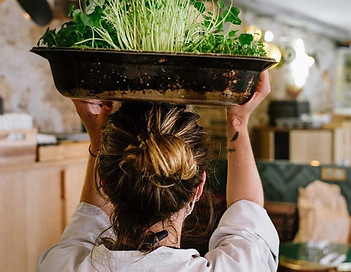
Eleonore, a graduate of the prestigious Parisian cooking school Ferrandi, has a love for health through nourishment. Also a naturopathe, Eleonore has a vast knowledge of how to take care of our gut health--our microbiome--and live better lives. Specializing in anti-inflammatory, non-gluten and vegetarian cuisine, Eleonore guides our guest's palates and meals with a soft touch, creating mouthwatering meals made from only the best ingredients. We welcome Eleonore to T610 as our main freelance chef.

Lux and Ody
Resident Therapy Cat and Dog
Lux, our bengal cat and Ody, our adopted dog, have shown how us how adaptation is the key to happiness. Originally a Parisian city cat, and an abandoned dog from a far away mountain range, they moved to the wilderness of Portugal to live with us. Having to deal with foxes, wildcats, frogs and a host of other creatures of the nature of Tinhela610, they have come out thriving. Ody is just waiting to be invited for a snooze with you in your cabin or a cuddle on the steps. Lux, is more private and tends to "select" her people...you may be the lucky one. They both live outdoors, their main job being to curb any thoughts of mice who may like to settle here! Or any others who may intrude our try to catch our chickens? Other than that they are our masters of unconditional love.
A Place to Breathe.
Our whimsical map to give you something to dream about for your visit to our enchanted kingdom.
Illustration by Lily Allegra

The origins of our name, Tinhela610
The Fibonacci Sequence — Where Nature Teaches Us to Begin Again
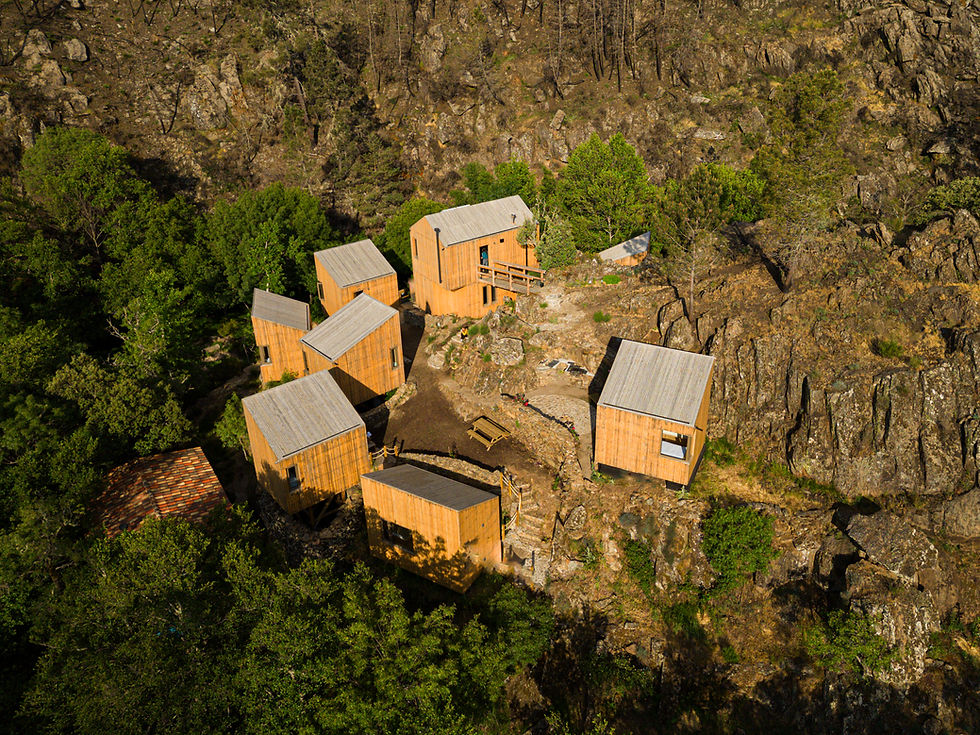
Our name, Tinhela610, holds the memory of this rustic and sacred land. Tinhela is the name of the river that runs along the perimeter of our land. The name of this place carries both geography and mystery. When we first stood on this land—quiet, raw, and embraced by the flow of the Tinhela River—we knew we had to find a name that honored both its visible beauty and its unseen rhythm. The early plans called it Matos dos Moinhos—The Mills in the Woods—after the old stone ruins scattered in the valley. A name of memory, rooted in place. But it didn’t quite capture what we felt pulsing here. One day, in a stack of sketches from our architect, Luís Rebelo de Andrade, we found a note. A simple line: “Tinhela 610m.” It marked the elevation of the river where it runs through the land. A practical annotation, yet it stopped us. The number—610—echoed somewhere deeper. We soon remembered why. 610 is part of the Fibonacci sequence, that timeless pattern found in ferns unfurling, shells spiraling, sunflowers blooming, galaxies expanding. A sequence that whispers of balance between order and wildness, logic and mystery. And suddenly, it made sense. Tinhela610 tied us to the river that nourishes this land, but also to the universal rhythm that sustains all living things. It was both local and cosmic, grounded and infinite. Since then, we’ve let Fibonacci guide our steps. Our fire circle spirals outward in his curve. Our cabins are numbered in the sequence: 21, 34, 55, 89, 144, 233, 377—a rhythm for those who notice. As Thoreau once said, “The world is but a canvas to our imagination.” For us, Tinhela610 is more than a name—it is a way of seeing. A reminder that every stone, every tree, every current of water is part of a greater